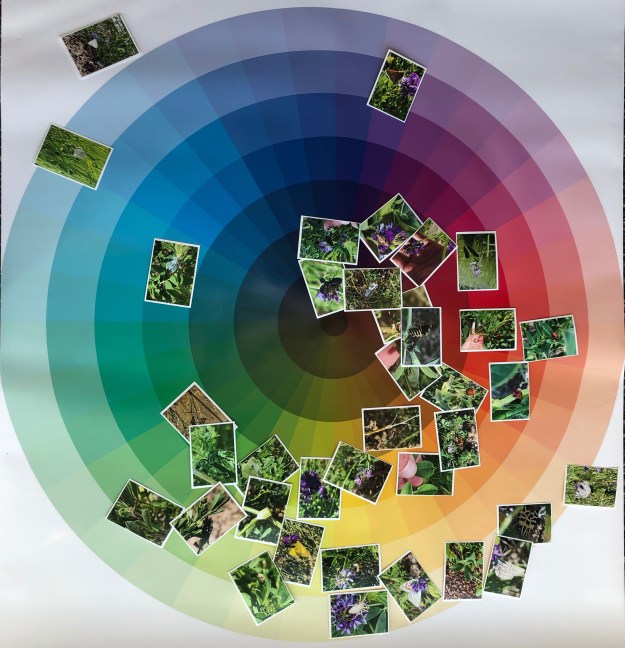
At USU’s Science Unwrapped public science outreach event in November, Lauren Lucas (pictured above) engaged budding science enthusiast of all ages by allowing them to explore the diversity of arthropods found on alfalfa, an introduced crop plant that has established feral populations across the western USA. This is linked to our own NSF Dimensions of Biodiversity project on the evolution of novel ecological interactions between this introduced plant and arthropods (especially the butterfly Lycaeides melissa) and microbes. Participants were encouraged to classify arthropods based on color (see below) as a way to visualize diversity in a manner accessible to non-specialists.
Alan Bergland and I organized and hosted an ASN symposium on the “Causes and consequences of temporally fluctuating selection in the wild” at the Evolution meeting in Providence, RI this past summer. A brief description of the symposium and links to the talks can be found below.
It has long been appreciated selection pressures fluctuate through time. However, the extent to which fluctuating selection pressures promote the long-term maintenance of functional genetic diversity and how functional variation within a species shapes ecological interactions remain open questions. Our symposium seeks to address these basic questions by (i) highlighting recent theoretical developments on the footprints of fluctuating selection and stability of balanced polymorphism, (ii)showcasing recent work identifying abiotic drivers of fluctuating selection from genomic data, and (iii) examining how fluctuating selection, and consequent adaptation, affects ecological dynamics and interactions.
Alan Bergland: Our contemporary understanding of the causes/consequences of temporally fluctuating selection.
Moises Exposito-Alonso: Natural selection in the Arabidopsis genome in present and future climates.
Jason Bertram: Can fluctuating selection stabilize polymorphism at many loci?
Meike Wittmann: Stable polymorphisms due to seasonally fluctuaing selection and their genetic footprint.
Seth Rudman: Repeated phenotypic and genomic evolution in response to seasonality in experiment Drosophila populations.
Carlos Melian: Tangling the webs of life.
And here is my own talk, which was not part of the symposium, but fits with the topic.
Zach Gompert: Measuring selection on polygenic traits in heterogeneous environments.
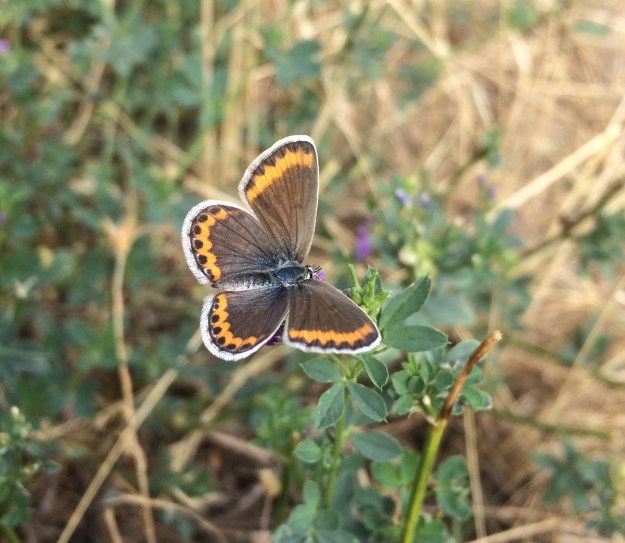
The USU Biology Department is moving into a new building this spring, and the new building includes a Science Garden Laboratory that was developed as an extension of our lab’s Dimensions of Biodiversity NSF grant (DEB #1638768). The garden includes ~200 alfalfa (Medicago sativa) plants. This is a host plant currently used by Lycaeides butterflies, and one key area of research in our lab considers the recent and repeated shift of L. melissa butterflies from various native legumes to this introduced host plant. These specific plants were used in an experiment this past summer, and will be used in a number of experiments on plant-insect interactions run by undergraduates as part of the introductory biology sequence (led by Lauren Lucas). Some of these experiments will be conducted in collaboration with my lab group. You can read an article about the Science Garden Laboratory here.
A picture of the garden shortly after we finished planting.
Our paper (led by Lauren Lucas) on wing pattern genetics and evolution in Lycaeides butterflies is out now as part of a Molecular Ecology Resources special issue on association mapping in natural populations. In this paper, we investigate the genetic architecture of complex wing pattern variation in Lycaeides butterflies as a case study of mapping multivariate traits in wild populations that include multiple nominal species or groups. We take a genomic prediction approach that accounts for the possibility that wing pattern elements are affected by many genetic loci with small effects, and we assess trait architectures at multiple hierarchical levels of biological organization. We identify conserved modules of integrated wing pattern elements within populations and species, and we find evidence that evolutionary changes in wing patterns among populations and species occur in the directions of genetic covariances within these groups. Thus, we show that genetic constraints affect patterns of biological diversity (wing pattern) in Lycaeides, and we provide an analytical template for similar work in other systems.
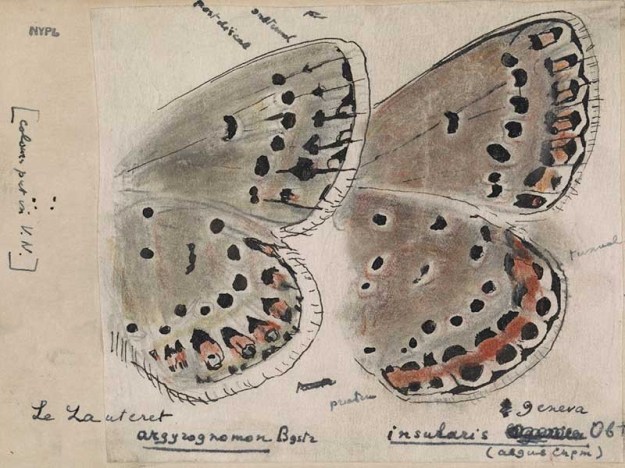
You can check out the entire special issue here, and see PhD student Amy Springer’s awesome digital drawings of Lycaeides wing patterns below.
Sam’s paper on the the predictability of genome‐wide evolutionary changes associated with a recent host shift in the Melissa blue butterfly (Lycaeides melissa) is now out in Molecular Ecology. The main messages from this paper are that predictability is quantitative rather than binary, and that evolutionary change can be more or less predictable depending on the basis of those predictions. Specifically, we show that genome-wide evolutionary changes are better predicted from comparison among repeated host shifts than from gene-by-performance associations detected in lab experiments.
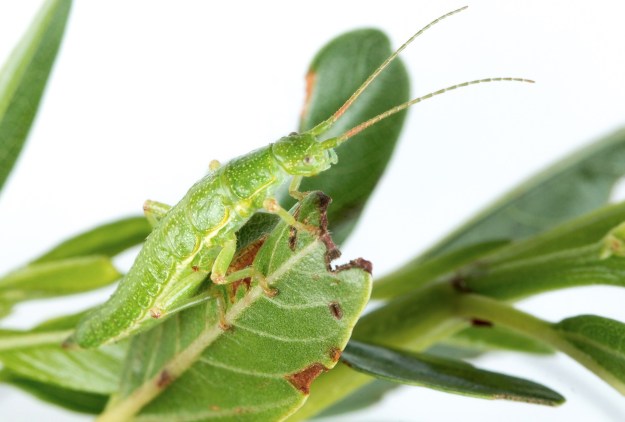
Timema cristinae, Ceanothus, PR, photo by Moritz Muschick
Check out our new paper the predictability of morph frequency evolution in Timema cristinae stick insects, which was published this week in Science. Patrik Nosil and I each wrote blog posts on the paper.
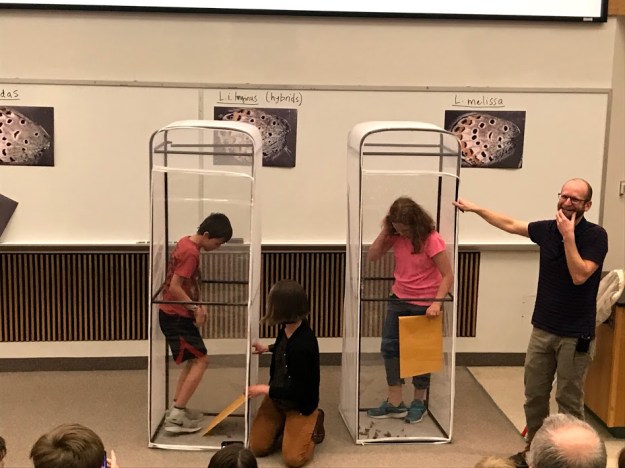
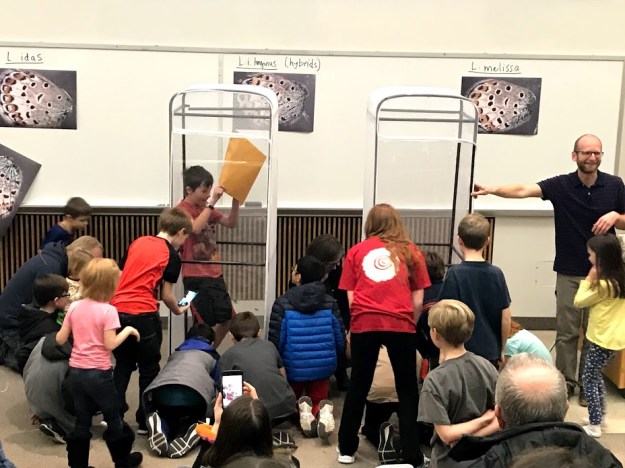
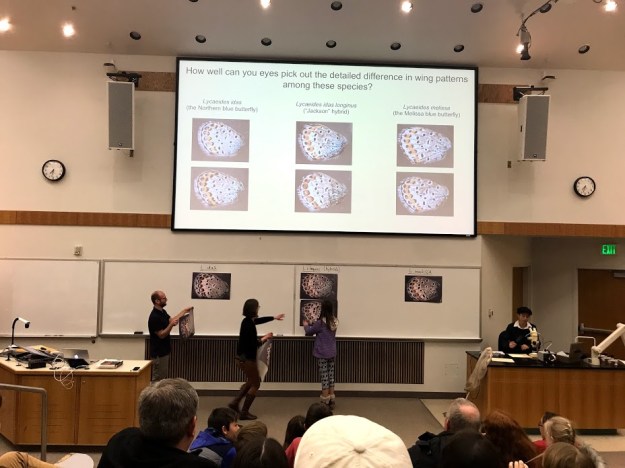
We (Lauren and I) gave a public talk as part of USU’s Science Unwrapped series on the connection between art and science in Vladmir Nabokov’s work as a novelist and systematist and the connection of his work to our own on Lycaeides butterflies. PhD student Amy Springer made a guest appearance as Nabokov and the whole lab was involved in activities related to talk. Check out the full video below, which includes a butterfly release by kids in cages.
In a new ‘From the Cover’ paper out in Molecular Ecology (led by Doro Lindtke), we show that color and color pattern in Timema cristinate map to a single region of reduced recombination (likely an inversion) and that overdominance (i.e., heterozygote advantage) promotes the persistence of green and melanistic color morphs. The paper was accompanied by a News and Views piece on the role of balancing selection in the maintenance of variation.
This photo, taken by Moritz Muschick, shows green (unstriped) and melanistic Timema cristinae color morphs and appears on the cover of Molecular Ecology volume 26, issue 22.
Sam’s paper assessing determinants of variation in Lycaeides melissa caterpillar gut microbiomes is out now in Scientific Reports. We were interested in whether evolutionary or plastic changes in gut microbiome were critical in colonizing novel host plants. Our results presented in this paper suggest that this isn’t the case, and join a growing body of evidence pointing towards a more limited role of gut microbes in Lepidoptera in general (relative to other taxonomic groups where gut microbes are clearly important for growth and development).
You can listen to Sam discuss this work and her research more generally on this Slightly Evolved podcast.







 The Gompert Lab